
Recycling and waste management
Our waste management strategy begins with carefully selecting sustainable materials and efficient building methods. In addition, we focus on reducing construction waste at every stage of the process to ensure a more environmentally friendly and cost-effective build.
Our Methodologies
- Efficient off-site fabrication helps reduce material waste and improves construction accuracy.
- Careful design planning and precise measurements minimise unnecessary material usage.
- Ongoing material management and organised storage help prevent damage and excess waste.
- Our panelised building system can be dismantled and reused, supporting sustainable construction practices.
- Unlike traditional concrete foundations, our pile footing system can be removed and reused when needed.
- Any remaining treated timber and sheet materials are responsibly collected and processed by a licensed waste management company.
Our Materials
- Timber is a natural, non-toxic material that does not break down into harmful substances that could damage the environment.
- Our timber structural framework can be carefully disassembled at the end of its lifespan and reused in future projects.
- The insulation we use, made from recycled newspaper, is both environmentally friendly and reusable.
- Our galvanised pile footing system can also be removed and reused, providing a more sustainable alternative to traditional concrete foundations.
Sustainable Materials
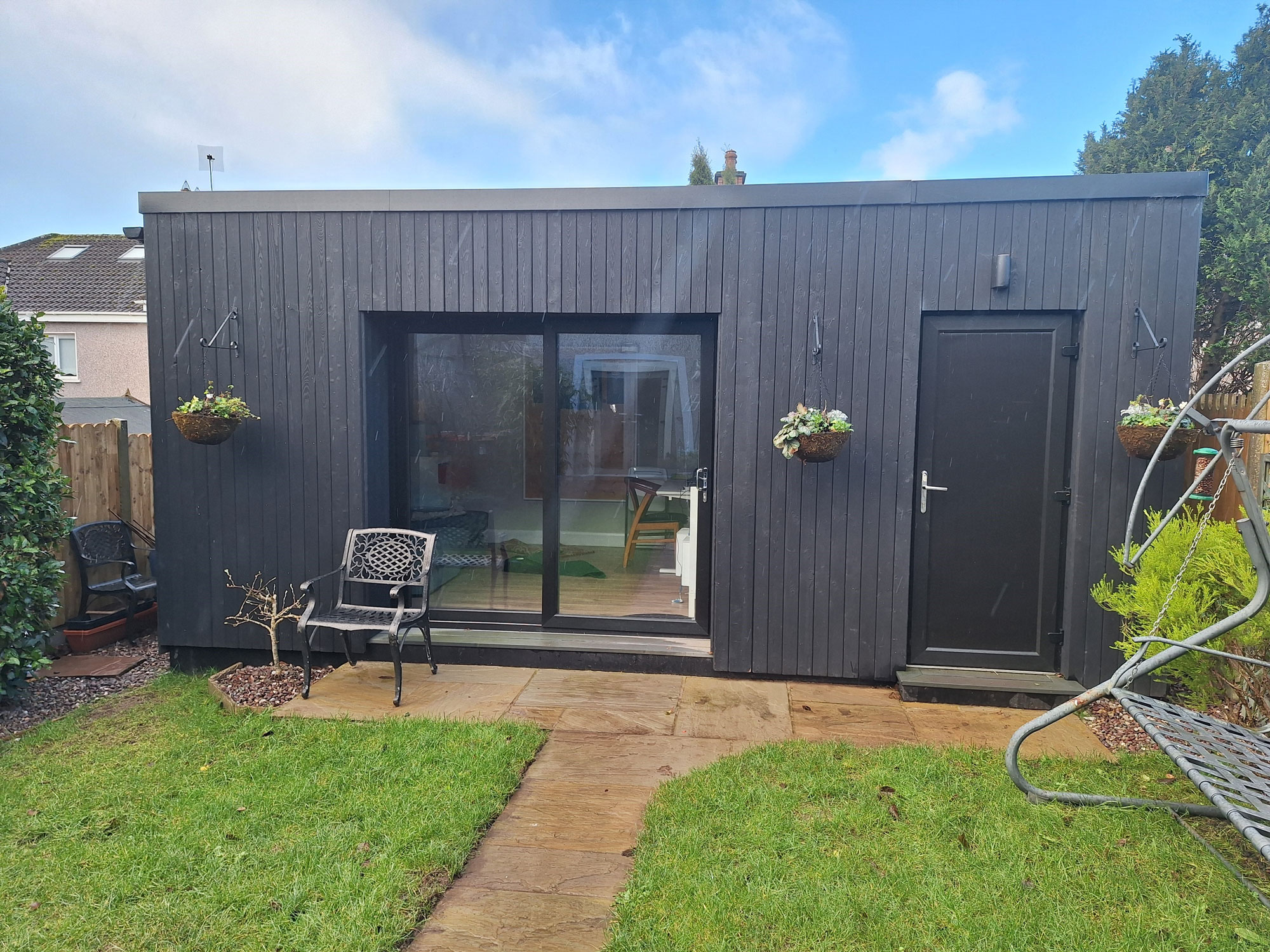
At Blue Mountain Garden Rooms, sustainability is at the heart of everything we do. We use locally grown, FSC-certified timber as the main structural component significantly reducing long-term environmental impact. Our environmentally friendly insulation is produced just a short distance from our facility using recycled newspaper materials.
Using locally sourced materials not only supports Irish businesses but also helps minimise the environmental impact associated with long-distance transportation.
You can also explore the benefits of sustainable insulation materials through Recycle Ireland.
Low-Impact Foundations
Our innovative pile foundation system provides a low-impact and environmentally conscious alternative to traditional concrete foundations. Unlike concrete bases, our galvanised pile system can be removed and reused at the end of the building’s life,
significantly reducing long-term environmental impact.
Furthermore, this installation method requires minimal ground disturbance, helping to preserve the surrounding landscape while reducing emissions associated with excavation and concrete production. By avoiding traditional concrete foundations, we also help reduce the release of harmful greenhouse gases, including nitrous oxide emissions linked to construction activities.
To discover more about our eco-friendly construction methods, visit:
- [About Us]
- [Eco-Friendly Prefab Homes]
- [Contact Us]
For further reading on sustainable construction and environmental impact reduction, visit World Green Building Council.
Durable and Long-Lasting Materials
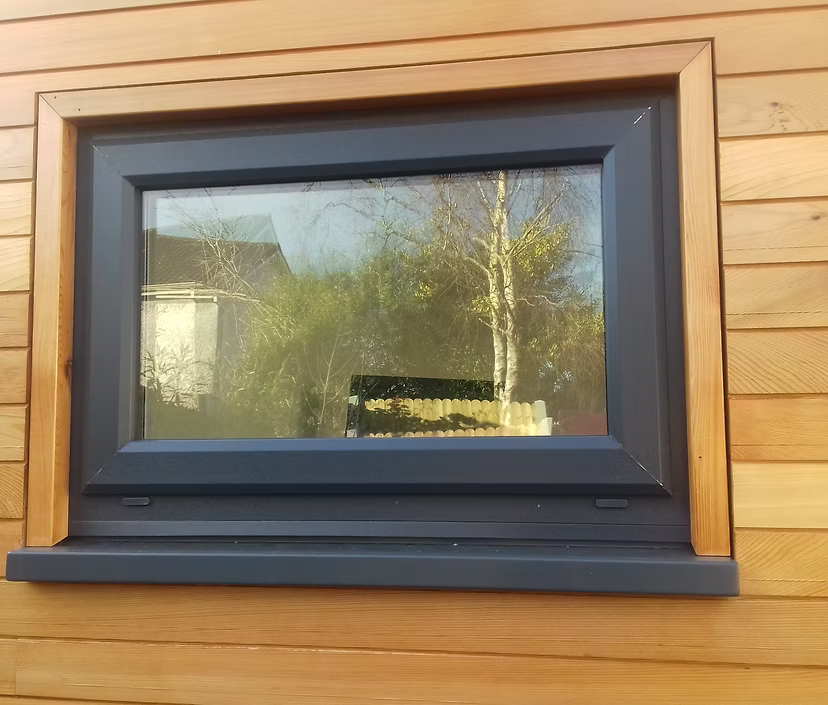
At Blue Mountain Garden Rooms, we believe durability is a key part of sustainable construction. That is why we carefully select high-quality materials designed to stand the test of time. Our external cedar cladding has an expected lifespan of up to 40 years, while the specialist membranes and sealing tapes used throughout our builds are designed to last for more than 100 years.
By investing in durable materials, we create prefab homes and garden rooms that require less maintenance, reduce replacement waste, and provide long-term value for homeowners.
Explore more about our:
- [Prefab Homes Ireland]
- [Garden Rooms]
- [Sustainable Building Practices]
You can also learn more about sustainable timber cladding through Wood Campus Ireland.
Sustainable and Replicable Building Methods
We believe that simplicity and replicability are essential components of truly sustainable construction. For this reason, our building systems are designed using proven methods, locally available materials, and practical construction techniques that align with best practices in the Irish construction industry.
As a result, our eco-friendly prefab homes can be efficiently reproduced without compromising on quality, sustainability, or performance. This approach helps ensure consistent standards while supporting local skills, suppliers, and sustainable building practices across Ireland.
To learn more about sustainable building standards, visit Irish Green Building Council.
Reduced Carbon Footprint
Independent assessments carried out by carbon consultancy specialists Sustineo show that our building system achieves a net carbon benefit. In simple terms, this means our structures store more carbon than is produced during the manufacturing and construction process.
Compared to traditional log cabins and conventional block-built structures, our prefab building system performs significantly better in terms of environmental impact. By using sustainably sourced timber, recyclable materials, and low-impact construction methods, we help reduce overall carbon emissions while delivering energy-efficient homes designed for modern living.
Related pages:
- [Eco-Friendly Homes]
- [Sustainable Garden Rooms]
- [Contact Blue Mountain Garden Rooms]
Low Carbon Footprint
Below are the results of a carbon footprint analysis applied to a 12m2 garden room. The data shows how BLUE MOUNTAIN’s system compares with a log-built version and a block built version.
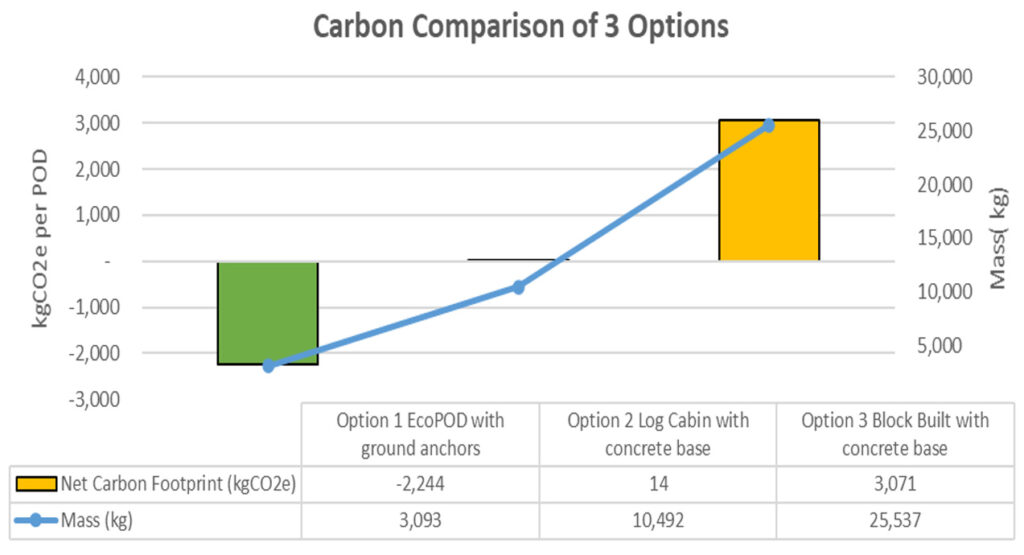
Calculations account for the embodied carbon of all the materials used in the construction of three options (base, walls and roof).
- 29% of the mass of a comparable log cabin with concrete base, resulting in a 71% material resource saving.
- 12% of the mass of a comparable block-built pod with concrete base, resulting in a 88% material resource saving.
- Our choice of materials have an embodied carbon footprint of 1,660 kgCO2e which is offset by the -3,900 kgCO2e stored in the biobased materials giving a net carbon footprint of -2,244 kgCO2e.
Into the Future
Our goal for next year which is currently in motion is to fit, as standard, environmentally friendly Marmoleum floor covering.
We would hope too, in the future, to change our internal finish which will completely remove the use of clean water out of the build process. We see this as our biggest, but not unsurmountable challenge.
Supporting Biodiversity Through Sustainable Building
At Blue Mountain Garden Rooms, protecting biodiversity is an important part of our sustainable building approach. That is why we use responsibly sourced wood products from FSC-managed forests, helping to support responsible forestry practices and preserve natural ecosystems and biological diversity.
Learn more about responsible forestry through Forest Stewardship Council (FSC).
Low-Impact Foundations and Minimal Ground Disturbance
Our innovative pile foundation system is designed to minimise environmental impact during installation. Unlike traditional concrete foundations, our footing system requires no heavy excavation machinery or extensive digging. As a result, the surrounding ground remains largely undisturbed, helping to protect nearby plants, wildlife, and natural habitats.
This low-impact approach not only reduces disruption to local flora and fauna but also supports more environmentally responsible construction practices.
Explore our:
- [Sustainable Building Solutions]
- [Eco-Friendly Prefab Homes]
- [Garden Room Designs]
Future Green Roof Solutions
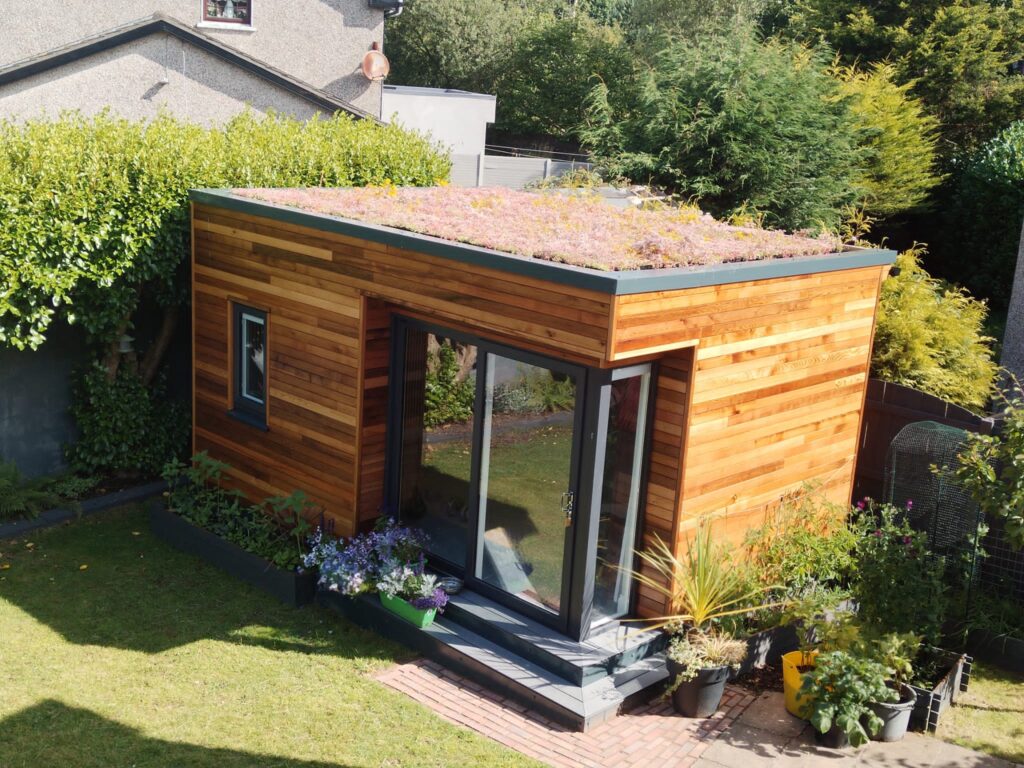
As part of our ongoing commitment to sustainability and environmental innovation, we modify our roof structure to facilitate green roof systems as an optional feature. Green rooves can help replace natural areas affected by construction while also supporting local biodiversity, improving insulation, and enhancing rainwater management.
In addition, green roofing systems can create valuable habitats for pollinators and native plant species, helping homeowners create more environmentally friendly outdoor spaces.
Energy and Water Management
At Blue Mountain Garden Rooms, we continually look for ways to reduce resource consumption throughout our construction process. As part of this approach, we have almost completely eliminated traditional wet trades from our builds, significantly reducing the use of processed water on site.
Ongoing Commitment to Efficiency
Despite challenges, we remain committed to refining our processes and improving sustainability across all aspects of our builds. By reducing reliance on water-intensive methods, combined with the removal of cementitious products and adopting more efficient construction techniques, we continue to move towards a cleaner, faster, and more environmentally responsible building model.
Explore more:
- [Sustainable Building Practices]
- [Eco-Friendly Prefab Homes]
- [About Blue Mountain Garden Rooms]
For more information on low-water construction methods, visit World Green Building Council.
Sustainable Transport Initiatives for Eco-Friendly Construction
At Blue Mountain Garden Rooms, sustainability extends beyond the build itself to include how materials are transported. One of the key advantages of timber construction is that it is significantly lighter than traditional materials such as concrete. As a result, transport is more efficient, requiring less fuel and helping to reduce overall carbon emissions.
Reduced Carbon Emissions Through Lighter Materials
Because timber weighs considerably less than concrete, it places less demand on transport vehicles. (Our garden rooms are approximately one-fifth the weight of and equivalent block-build). This leads to improved fuel efficiency and a measurable reduction in transport-related emissions. In turn, this supports a more sustainable and environmentally responsible construction process.
Local Sourcing to Reduce Transport Impact
Where possible, we prioritise locally sourced timber to further reduce the environmental impact associated with long-distance transportation. By working with Irish suppliers, we help shorten supply chains, reduce delivery distances, and support a lower-carbon construction model.
Modern, Low-Emission Delivery Methods
In addition, we recognise the importance of modern logistics in reducing environmental impact. The use of eco-friendly transport solutions, including electric and low-emission vehicles, can further improve the sustainability of material delivery. Combined with lightweight timber construction, these methods contribute to a cleaner and more efficient building process.
The Drive towards A More Sustainable Construction Supply Chain
When lightweight materials, local sourcing, and low-emission transport are combined, they create a significantly more sustainable supply chain. This approach not only reduces environmental impact but also supports the broader transition towards greener construction practices in Ireland.
Explore more:
- [Sustainable Building Practices]
- [Eco-Friendly Prefab Homes]
- [About Blue Mountain Garden Rooms]
For further reading on sustainable transport and emissions reduction, visit European Environment Agency.
Long-Term Environmental Impact of Sustainable Construction
At Blue Mountain Garden Rooms, we recognise that the construction industry plays a major role in global carbon emissions. It is estimated that buildings account for approximately 39% of global CO₂ emissions when both construction and operation are considered. In addition, embodied carbon—the emissions associated with building materials alone—accounts for around 11% of global emissions and is projected to exceed 230 gigatons by 2060.
Understanding Carbon Hotspots in Construction
Because of this significant impact, it is essential to understand where emissions occur throughout the lifecycle of a building. From material production and transportation to construction methods and long-term energy use, identifying these “hotspots” allows the industry to make more informed and sustainable decisions.
By focusing on low-carbon materials, efficient design, and reduced waste, we can significantly improve the environmental performance of modern buildings.
A Low-Carbon Future for the Construction Industry
We believe that lightweight, timber-based construction methods—when properly developed, scaled, and improved—have the potential to transform the building industry. This approach reduces embodied carbon, minimises waste, and supports more efficient construction practices.
If widely adopted and continuously enhanced, this type of sustainable building system could help position the construction sector to meet the urgent challenges of climate change. Ultimately, it supports the transition towards a low-carbon, resource-efficient, and environmentally responsible future.
Explore more:
- [Sustainable Building Practices]
- [Eco-Friendly Prefab Homes]
- [About Blue Mountain Garden Rooms]
For further information on global emissions and the built environment, visit Intergovernmental Panel on Climate Change (IPCC).